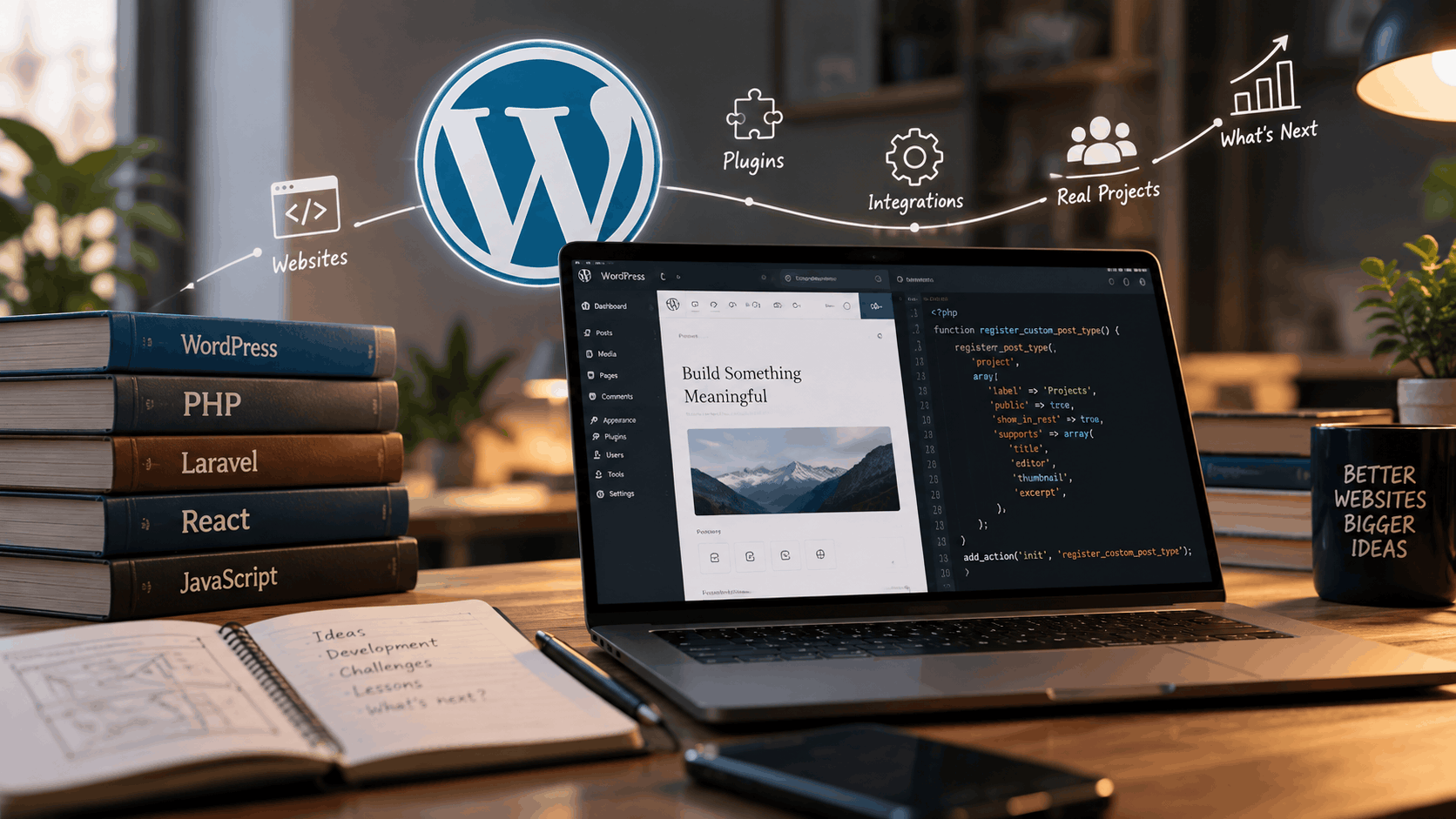
Nine years ago (or even 10), I started working with WordPress. Back then, most of my work involved building websites, customizing themes, and writing PHP to make things work the way clients needed.
A lot has changed since then.
Over the years, I've worked on hundreds of WordPress websites, developed custom plugins, integrated third-party services, and contributed to complex applications, including a learning management system with over 400,000 registered users.
What started as building websites gradually turned into solving much more complex engineering problems.
WordPress Is More Than a Website Builder
One thing I've learned is that WordPress can be much more than a traditional CMS.
With the right architecture, it can support complex business logic, custom database structures, API integrations, and applications serving thousands of users.
But as projects grow, so does the importance of writing maintainable code.
Early in my career, I focused mainly on making things work. Today, I think much more about how the code will behave in a year, how easily another developer can understand it, and whether the architecture can support future changes.
I've also learned that the simplest solution is often the best one. Not every project needs complicated abstractions or dozens of classes.
One of the questions I was asked during the job interview was, “Do you agree that WordPress is just a blogging platform?”
And of course, I wasn't agree 🙂
Thinking Beyond WordPress
Working with WordPress also pushed me to explore other technologies.
Over time, I started working with Laravel, Symfony, React, Docker, and different infrastructure tools. Each of them changed how I approach software development.
Laravel, for example, influenced how I think about application architecture and separating business logic. Working with servers and deployment pipelines helped me better understand what happens to an application after the code is written.
I believe being a good WordPress developer means understanding more than WordPress itself.
It's about understanding the entire application, from the database and backend to the frontend and infrastructure.
AI and the Next Chapter
Recently, AI has become an important part of my development workflow.
I use AI-assisted tools to explore solutions, review code, and automate repetitive tasks. I'm also interested in building AI-powered applications, integrations, and agents that can solve real business problems.
I don't see AI as a replacement for engineering experience. It's another tool that becomes more useful when you understand the systems you're working with.
Although several of my friends have already lost their jobs because AI does a great job handling simple tasks and small websites.
Final Thoughts
After nine years, the biggest lesson I've learned is that software development isn't really about knowing a particular framework or CMS.
It's about understanding problems, making good technical decisions, and building solutions that remain reliable and maintainable over time.
WordPress has been a major part of my journey, but it has also opened the door to broader full-stack engineering.
And with AI changing how we build software, I'm excited to see what comes next.
Personally, thanks to AI, I've finally started working on some of my pet projects, because now I can build an MVP in a few days instead of months, which is awesome.